
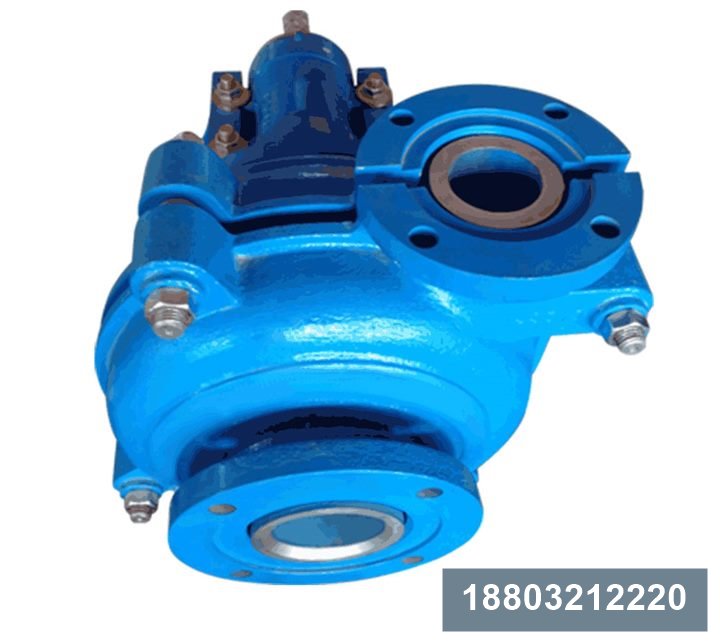
AH Heavy-duty Horizontal Pump
Cantilever dual-casing pump with replaceable metal or rubber liners for mill discharge, mineral processing, tailings, coal prep and power ash removal; multistage series available.
Product photos and typical duty for each series; flow and head are reference ranges. Actual discharge size, impeller diameter, power and material are matched to the final duty.
Cantilever dual-casing pump with replaceable metal or rubber liners for mill discharge, mineral processing, tailings, coal prep and power ash removal; multistage series available.
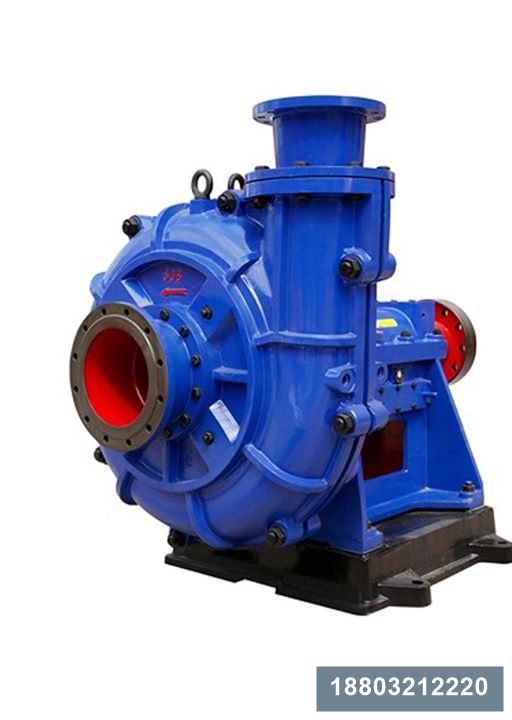
Single-stage single-suction horizontal pump with broad performance coverage for concentrate and tailings transport, coal dense medium, power ash handling and building-materials slurry.
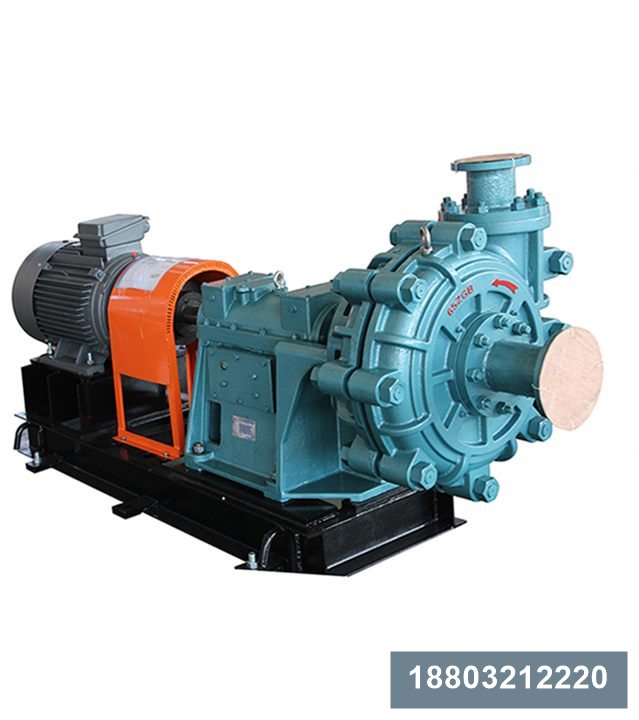
Heavy dual-casing horizontal pump with generous pressure and wear margin for high-concentration, highly abrasive slurry and complex media.
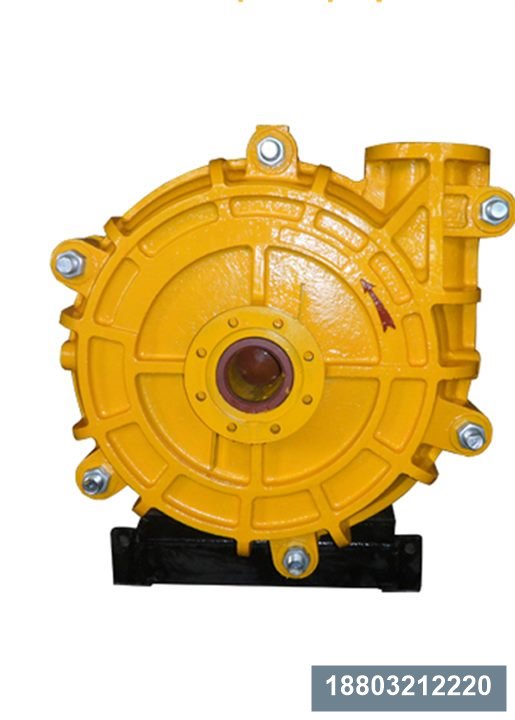
High-head, high-pressure design for long-distance pipeline transport, high-pressure feed, multistage series and underground high-head dewatering.
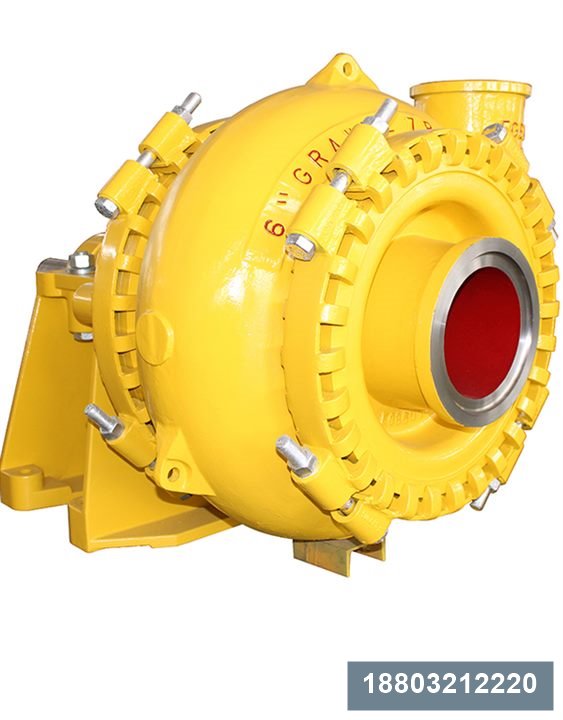
Large-particle passage design for river sand extraction, dredging, aggregate suction and slurry carrying large solids.
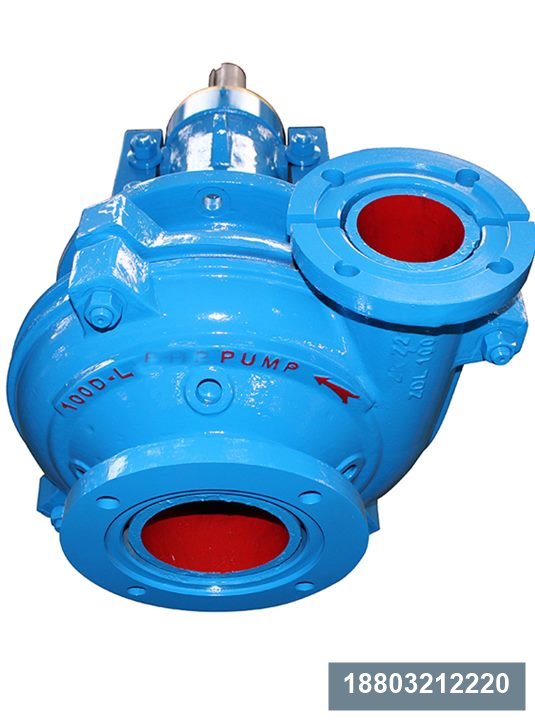
Compact, lighter pump for light-to-moderate abrasion slurry, chemical dilute slurry and tail water transport.
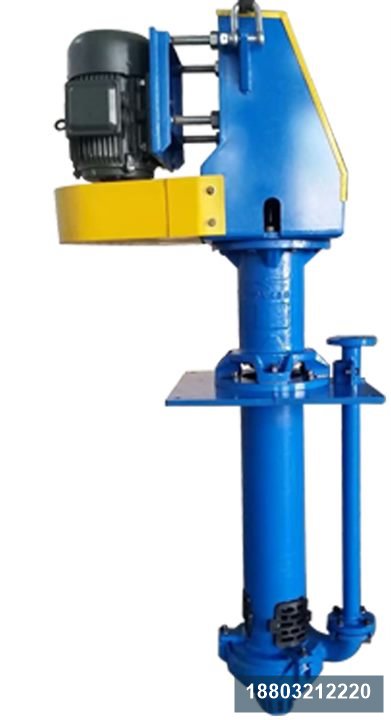
The wet end is submerged with no priming required, for slurry lifting and discharge from sumps, settling ponds, sewage pits and low-lying accumulations.
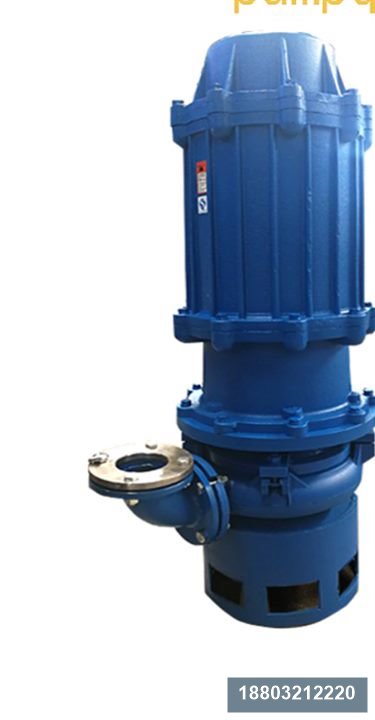
Motor and pump in one immersed unit, mobile and flexible, for tailings pit cleaning, reservoir desilting and locations where dry installation is impractical.
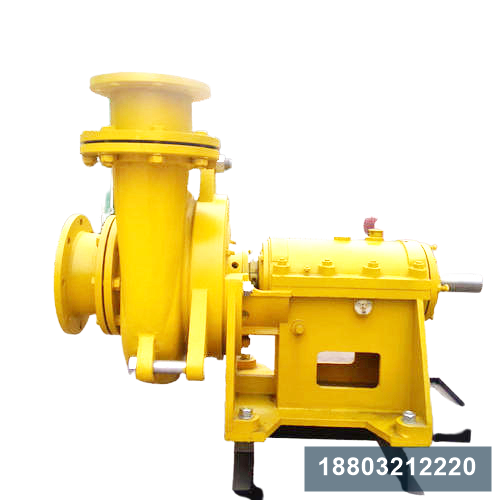
Large-flow slurry circulation pump for limestone / gypsum slurry (FGD) in thermal power, aluminum and similar plants, balancing wear and corrosion resistance.
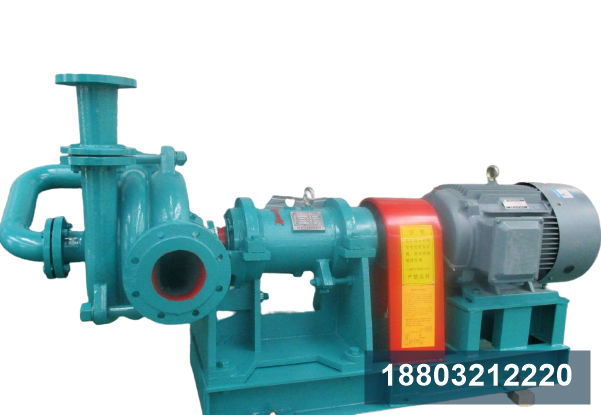
Low-flow, high-pressure centrifugal pump feeding filter press equipment with stable, uniform pressure, matched to filter press size and filtration pressure.
| Series | Configuration | Typical duty | Reference range | Materials |
|---|---|---|---|---|
| AH series | Cantilever horizontal, dual casing | Highly abrasive, high-concentration mineral slurry, cyclone feed, mill discharge, tailings; multistage series available | Models 1.5/1B–20/18TU-AH; flow 12.6–5400 m³/h; head 5.5–68 m; speed 200–3800 r/min | High-chrome alloy / rubber liner |
| ZJ series | Single-stage single-suction horizontal | Mineral processing, coal prep, power ash handling, building materials slurry; broad performance coverage | Models 50ZJ–350ZJ-I; flow approx. 280–3740 m³/h; head 8.4–128.7 m | High-chrome alloy / rubber liner |
| ZGB series | Horizontal dual-casing heavy-duty | High-concentration, highly abrasive slurry and complex media transport | Models 65ZGB–300ZGB; flow 50–1800 m³/h; head 50–94 m | High-chrome alloy / rubber liner |
| HH series | Horizontal high-head heavy-duty | Long-distance pipeline transport, high-pressure feed, multistage series, underground high-head dewatering | Models 1.5/1C–6/4X-HH; high-head high-pressure, matched by impeller diameter and speed | High-chrome alloy |
| G type gravel pump | Horizontal large-particle passage | River sand extraction, dredging, aggregate suction and slurry with large solids | Models 6/4D–14/12G-G; large-particle passage, matched to duty | High-chrome alloy / rubber liner |
| SP / ZJL series | Vertical submerged | Slurry lifting and discharge from sumps, settling ponds and sewage pits and low-lying accumulations | Models 40PV–300TV-SP / 40–150ZJL; flow 17.3–1267 m³/h; head 4–40 m, matched to submerged depth | High-chrome alloy / rubber liner |
| ZJQ series | Submersible, motor and pump in one unit | Tailings pit cleaning, reservoir desilting, low-lying water and locations where dry installation is impractical | Models 50ZJQ–200ZJQ; flow 50–1000 m³/h; head 15–40 m | High-chrome alloy / rubber liner |
| DT series | Horizontal FGD circulation pump | Limestone / gypsum slurry circulation in thermal power, aluminum and other FGD plants | Models 40DT–800DT; flow 500–16000 m³/h; head 6–54 m; slurry temp ≤65℃, pH 4–13, weight concentration ≤60% | Wear-resistant corrosion-resistant alloy / rubber liner |
| SYA / ZJE feed pump | Horizontal high-pressure centrifugal | Feeding filter press equipment with stable, uniform pressure | Models 50SYA–125SYA / 50–125ZJE; low flow high pressure, matched to filter press size and filtration pressure | High-chrome alloy |
A slurry pump is a type of centrifugal pump used to transport liquids carrying suspended solid particles; it is a key piece of equipment in mineral processing, coal preparation, power ash handling and dredging flows. Compared with a clean-water pump, its impeller and flow passages are reinforced for abrasion: passages are wider to prevent particle clogging, walls are thicker to resist scouring, bearings and shaft train are sized for heavy duty, and the seal must keep particle-laden slurry from leaking along the shaft.
By configuration they are grouped into horizontal, vertical (submerged) and submersible types; by casing into single- and dual-casing; and by number of stages into single- and multistage. Products serve mining and mineral processing, tailings transport, coal dense medium, power ash removal, FGD, river dredging and sand extraction, building materials, chemicals and wastewater treatment.
Centrifugal force from the high-speed impeller transfers mechanical energy from the drive to the slurry, maintaining continuous suction and discharge.
Slurry enters the low-pressure zone at the impeller eye and is continuously fed in under head pressure to keep the inlet stable.
Motor or diesel drive spins the impeller; vanes push the slurry along the passages, building velocity and pressure energy.
Slurry thrown into the volute casing slows down, and most of the kinetic energy converts to pressure energy.
Pressurized slurry leaves through the discharge nozzle into the pipeline; the low-pressure impeller eye keeps feed flowing continuously.
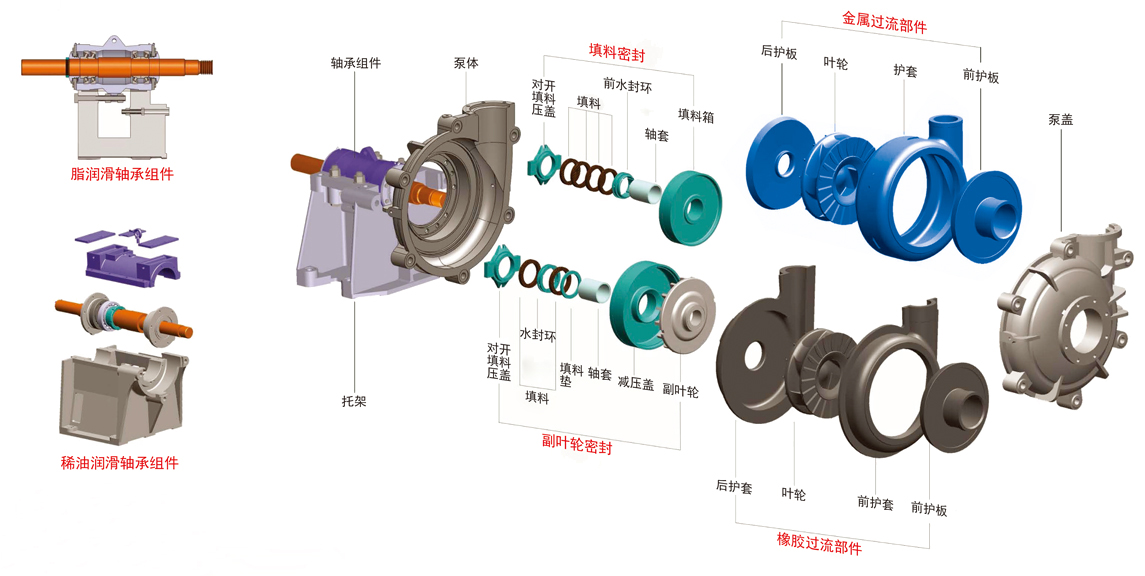
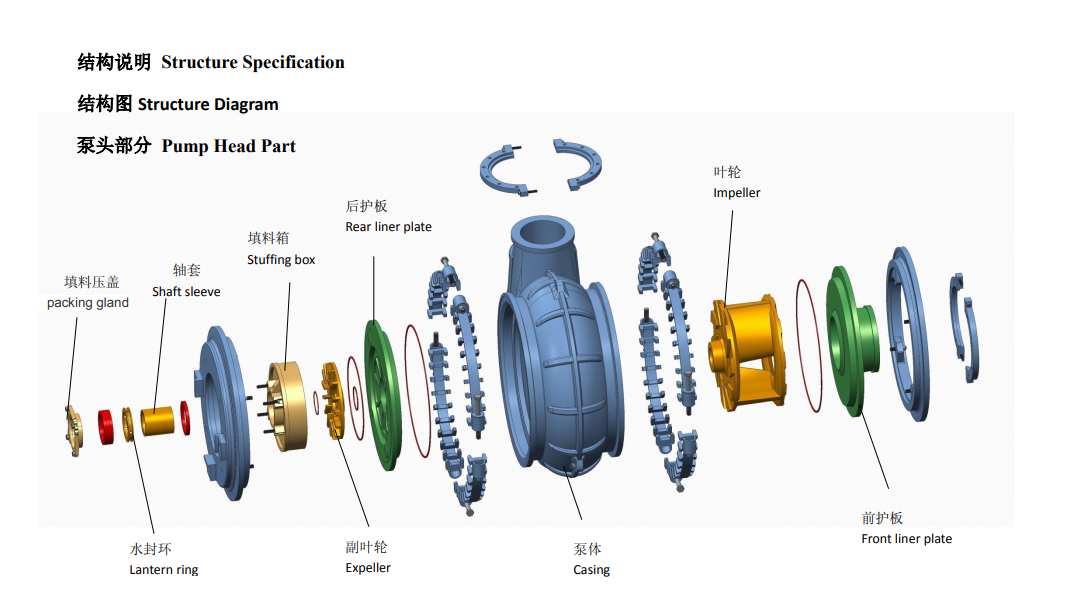
The exploded views below show the complete pump and pump-end assembly with main components labeled; wet-end, seal and bearing parts can be supplied and replaced individually by pump model.
| Component | Function |
|---|---|
| Bearing assembly (frame / bearing housing) | Supports the rotor at the drive end and carries radial and axial loads; available in grease-lubricated and oil-lubricated frames with a rigid shaft train for impeller-to-liner clearance adjustment. |
| Casing / volute liner | Collects slurry discharged by the impeller and converts kinetic energy to pressure; a replaceable liner that protects the outer casing when worn through. |
| Impeller | The core energy-transfer part in contact with slurry; closed, semi-open or open designs, in high-chrome alloy, wear rubber or stainless steel matched to particle and corrosion duty. |
| Front liner / throatbush | Inlet-side wear plate maintaining fit-up clearance with the impeller eye, absorbing inlet particle impact and protecting the cover and suction passage. |
| Rear liner | Wear plate behind the impeller, balancing backflow wear and reducing slurry scouring toward the cover and seal area. |
| Stuffing box / packing seal | Houses packing and flush-water connections; works with the water seal ring to distribute flush water and keep particle-laden slurry from leaking along the shaft. |
| Expeller / expeller cover | Mounted behind the main impeller, it generates reverse centrifugal pressure to stop slurry leakage during operation; packing seal backs it up at standstill. |
| Water seal ring | Sits inside the packing chamber to distribute flush water, forming a water film at the seal that blocks slurry ingress and lubricates the packing. |
| Shaft sleeve | Protects the shaft where it passes through the stuffing box and seal against particle wear and corrosion; replaced individually when worn, without replacing the whole shaft. |
| End cover / gland | End covers, bearing glands and packing glands seal the bearing housing and shaft end; together with oil seals and fasteners they protect the bearing chamber from dust, slurry and moisture. |
Pumps are grouped by mounting, casing structure and frame lubrication, selected according to site layout, slurry level and drive conditions.
Horizontal: shaft horizontal, broad capacity and head range, easy to service — the mainstream layout for mining, tailings and ash handling. Vertical submerged: wet end below sump level, no priming required. Submersible: motor and pump combined under slurry, mobile and without a separate pump house.
Double casing: outer casing carries pressure while wear liners are replaced individually, used for heavy, highly abrasive duties. Single casing: compact and lighter, for medium-to-low abrasion and light transport. Metal and rubber liners fit corresponding positions.
Grease-lubricated frame: simple lubrication for smaller pumps and intermittent duty. Oil-lubricated frame: bath or circulating oil with better heat dissipation and load capacity, for large pumps and continuous heavy duty. The exact lubrication follows the pump model configuration.
Slurry pumps transport and lift particle-laden slurry across the common industries below; pump type and material are selected from slurry parameters.
Grades below are commonly used for wet-end and structural parts in our spare-parts ledger, selected by abrasion, corrosion and impact duty; the exact grade follows the drawing for each pump model.
| Material Group | Common Grades | Typical Use |
|---|---|---|
| High-chrome wear alloy | KmTBCr26, KmTBCr15Mo3, KmTBMn5W3 | Impellers, volute and liners for coarse-particle, high-impact abrasion duties |
| Grey cast iron | HT150, HT200, HT250 | Frames, bearing housings, stuffing boxes, end covers and glands |
| Carbon / alloy steel | 45, 40Cr, A3/A3F, 20 | Shafts, locating sleeves, fasteners and other drive/structural parts |
| Ductile iron | QT500-7, austempered ductile iron | Frames and expeller covers requiring pressure resistance and toughness |
| Stainless / cast steel | 1Cr18Ni9Ti, ZG1Cr18Ni9Ti, 3Cr13, 4Cr13, ZG230-450 | Corrosive-duty wet-end parts, seal rings, shafts and glands |
| Wear rubber | Natural rubber, NBR, synthetic rubber, neoprene, acid/alkali-resistant rubber | Rubber-lined impellers, volutes and liners for fine, non-sharp particles |
| Copper alloy | ZCuAl10Fe3 | Seal rings, bushings and other corrosion/wear-resistant matching parts |
Choose a horizontal pump where dry installation is possible, flow and head are large, and maintenance access matters. Use a vertical submerged pump when slurry sits below in a sump, tank or pit with limited space. Choose a submersible pump when the whole unit can be immersed, mobility matters, or a dry installation is impractical.
When pipeline distance is long, lift is high, or a single-stage pump cannot meet system head, a high-head heavy-duty pump or multistage series can be used. The number of stages and pump models must be calculated from the pipeline resistance curve and duty point.
FGD slurry combines abrasion with chloride corrosion; temperature is generally moderate but pH varies over a wide range. Wear-resistant corrosion-resistant alloy or corrosion-resistant rubber liner is normally used, and a better corrosion grade such as A49/Cr30 is preferred where chloride content is high. This should be confirmed against chloride level and slurry composition.
On most horizontal dual-casing pumps the discharge can be rotated in 45° increments to several angles to match site piping. The exact adjustable range depends on the pump model structure.
Share your slurry parameters and duty; we will help match the pump type, liner material and seal arrangement.